
TMV servicing across the UK
TMV Servicing Specialists arranges routine TMV servicing for homes, rented property and commercial premises across the UK. A partner engineer reads each valve's mixed temperature, proves it shuts down when the cold supply goes, gives it a light clean and writes down what was found. It is the regular visit that keeps a working valve working.
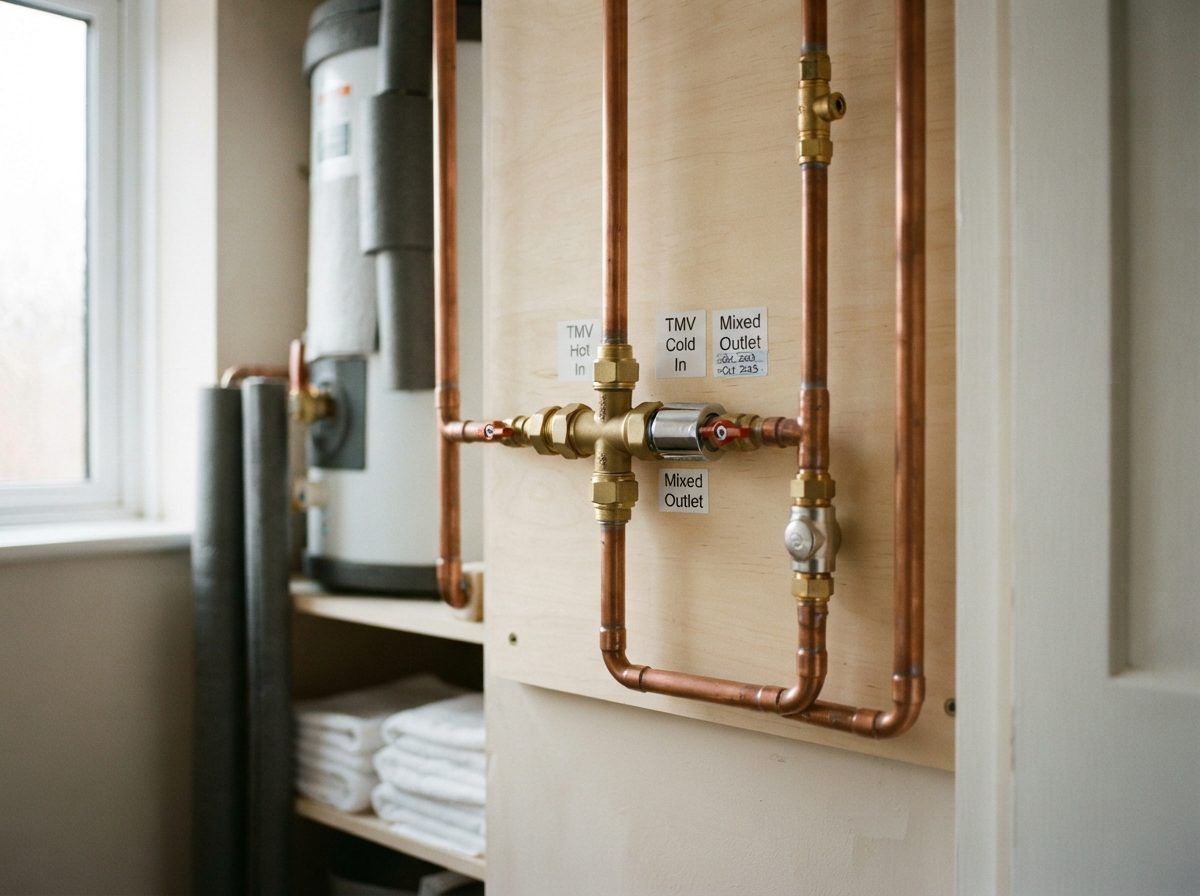
What a routine TMV service is for
A thermostatic mixing valve takes hot and cold water and blends them to a set temperature before the water reaches a bath, basin or shower. Over months of use the thermostatic element can drift, scale builds up on the moving parts and debris collects in the inlet strainers. None of this is visible from the tap. Routine TMV servicing is the scheduled check that catches it early: it confirms the valve still delivers water at its set point, still protects the user if a supply fails, and still has clean inlets.
This service suits anyone responsible for valves that are basically sound: a landlord with a TMV on each bath, a school with mixed water at pupil washbasins, an office with blended hot water in its washrooms, or a care setting that wants its routine round done and recorded. The engineer works through each valve in turn, outlet by outlet, and leaves a record you can file against your risk assessment or show to an inspector.
It is not the right visit for every valve. If a valve has drifted badly, will not hold a setting or fails its fail-safe test, it needs a full strip-down service or a repair rather than a routine check. If you only need the in-service test readings and no cleaning, TMV testing on its own may fit better. And if you do not yet know how many valves you have or where they are, a survey is the sensible first step.
What a routine service covers
The exact steps depend on the valve type and its access, but a routine service usually runs through the following for each valve.
- Readings as foundThe mixed temperature is taken at the outlet at full flow before anything is touched, so you can see how the valve was performing since its last visit.
- Supply temperaturesHot and cold supplies feeding the valve are measured. A low hot supply or a warm cold supply explains many odd readings and is worth knowing about in its own right.
- Fail-safe testThe cold supply is isolated and the outlet watched: flow should stop or drop to a trickle. When the cold is restored, the mixed temperature should come back close to the earlier reading.
- Light cleanInlet strainers or filters are taken out where they can be reached, rinsed of debris and refitted. Outlet aerators and shower heads can be checked for scale at the same time.
- Small adjustmentWhere the reading has crept away from the set point, the valve is brought back to it and the reading taken again once it has settled.
- Check of the outletLeaks at unions, a stiff isolation valve, a damaged hose or a missing cap are noted, because they affect whether the valve can be safely serviced next time.
- A record per valveReadings before and after, the fail-safe result and anything that needs further work are written down for each valve, ready for your logbook.
Before you book a routine service
-
A list of valves
Even a rough list of rooms and outlets with mixing valves helps the job to be priced and planned, and stops any valve being missed on the day.
-
Access to rooms and isolators
Engineers need to reach each outlet and the valve's isolation points, which may be behind a bath panel, in a ceiling void or inside a duct. Occupied rooms need notice.
-
Previous records
Set points, earlier readings and past service sheets let the engineer compare like with like and spot a valve that is drifting over time.
-
Hot water running normally
The boiler, cylinder or calorifier should be at its usual temperature on the day. A valve cannot be tested properly on a supply that is cold or switched off.
Good to know about routine servicing
-
Frequency comes from your risk assessment
No law names a set interval for TMV servicing. HTM 04-01 describes in-service testing based on how much a valve drifts, and most non-healthcare sites take their interval from their own risk assessment.
-
A routine service is not a strip-down
The cartridge is not normally removed or descaled on a routine visit. If the engineer sees that it needs that level of work, it is noted as further work.
-
Drift is useful information
A valve that holds within about a degree between visits can usually go longer between checks. One that moves more each time is telling you something about scale, wear or supply pressures.
-
The set point is a choice
Maximum temperatures commonly quoted for healthcare are 41°C at a shower or washbasin and 44°C at a bath. Lower settings can be chosen by risk assessment, and the engineer sets to what your site has agreed.
How booking a routine service works
- 1
Send an enquiry
Use the enquiry form to tell us where the premises are, roughly how many valves there are and what records you already hold.
- 2
Alex matches the job
Alex looks at the details and matches the visit to a partner engineer who covers your area.
- 3
Price agreed first
The price depends on the number of valves, their access and their type. We confirm it with you before any work starts.
- 4
The service visit
The engineer works through each valve: readings, fail-safe test, light clean and any small adjustment.
- 5
Records and next steps
A visit usually leaves you with a record for each valve and a list of anything that needs further work, such as a strip-down or a part.
TMV servicing questions
How often should a TMV be serviced?
That is set by the risk assessment for your premises. Many sites service annually; healthcare follows HTM 04-01, where the interval depends on how much each valve drifts between tests.
How long does a routine service take per valve?
It depends on access more than anything. A valve under a basin with good isolators is quicker than one behind a tiled bath panel, so the time is agreed as part of the price.
Will the water be off during the service?
Each outlet is out of use while its valve is being worked on, and supplies may be isolated briefly. Other outlets usually stay in use.
Does a routine service include descaling the cartridge?
No. A routine service is readings, a fail-safe test and a light clean. Descaling and replacing seals are part of a full strip-down service.
What if a valve fails its fail-safe test?
The outlet is noted as unsafe and you are told on the day. The usual next step is fault finding or repair, and the outlet should stay out of use until it is put right.
Do I need to keep the service records?
Yes. The records are your evidence that the valves are being managed under your risk assessment, and they make each later visit faster and more useful.
Can you service a valve fitted inside a shower?
Many thermostatic shower valves can be serviced in the same way. Some built-in valves have no separate strainers, and the engineer works with what the design allows.
Related TMV services
- TMV full serviceA strip-down, descale and reseal for valves that have drifted or will not hold their setting.
- TMV testingIn-service test readings and a fail-safe test, recorded against the set point, without the cleaning.
- TMV strainer cleaningDedicated cleaning of inlet strainers and checks on the check valves that stop cross-flow.
- TMV maintenance contractsA planned programme of visits so routine servicing happens on time at every valve.
Book routine TMV servicing
Tell us where your valves are and roughly how many there are. Alex will match the job to a partner engineer and confirm the price before any work starts.
Send an enquiry