
TMV questions answered
Short answers to the questions people most often ask about thermostatic mixing valves, how they are tested and serviced, the rules and paperwork around them, and how enquiries to TMV Servicing Specialists work. The guides go into more depth on each topic.
About TMVs
What is a TMV?
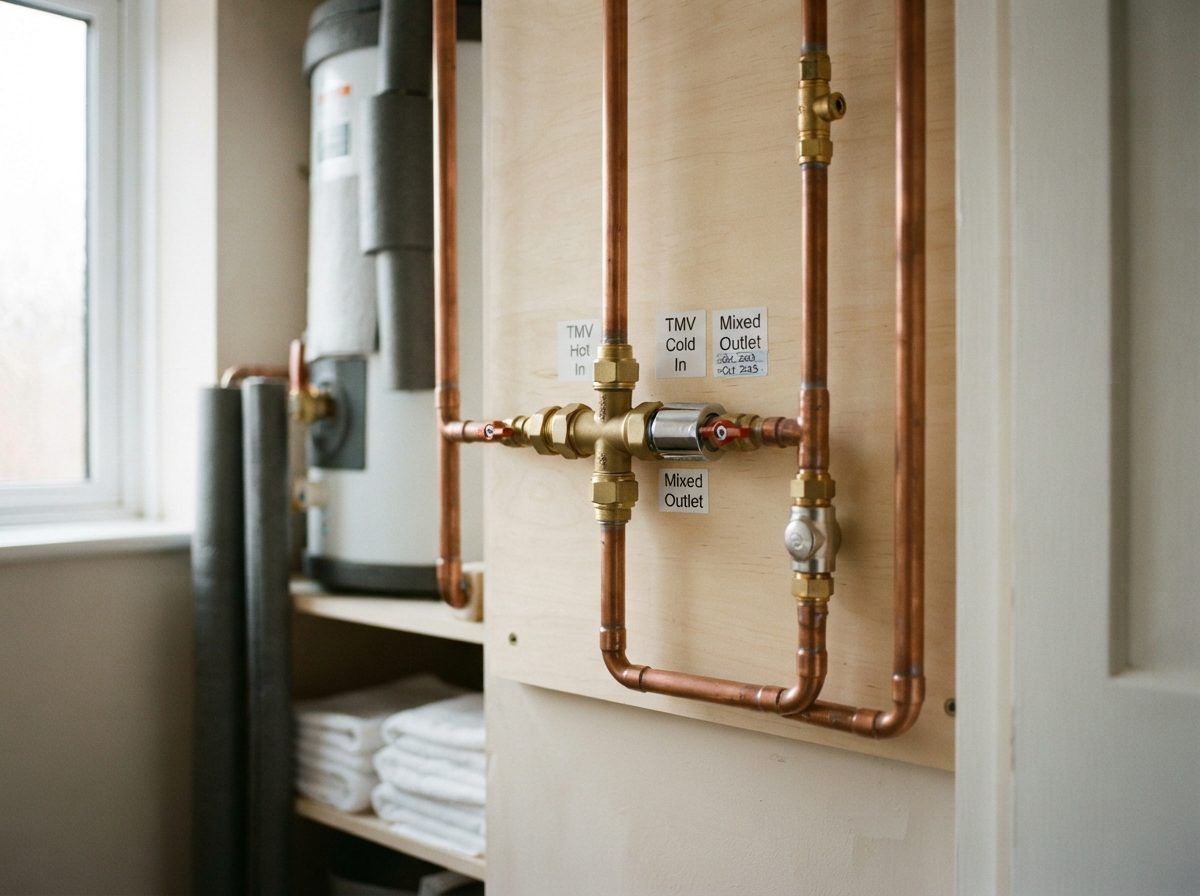
A thermostatic mixing valve blends hot and cold water to a set temperature and keeps it there as supply conditions change. Our guide to what a TMV is explains how it works.
Why are TMVs fitted?
To stop people being scalded at baths, showers and basins while the hot water system stays hot enough to control Legionella.
What does fail-safe mean?
If the cold supply fails, the valve should shut off or cut the flow to a trickle rather than deliver full-temperature hot water.
What is the difference between TMV2 and TMV3?
TMV2 is the scheme for domestic-type use; TMV3 is a higher-performance scheme for healthcare and similar settings, based on the NHS D 08 specification. Some valves hold both.
Is a thermostatic shower the same as a TMV?
Not always. Some thermostatic shower valves are tested to the same schemes as TMVs; others are domestic mixers with a temperature stop.
What temperature should a TMV be set to?
It depends on the outlet. Healthcare guidance recommends maximums of 41°C for showers and basins, 44°C for baths and 38°C for bidets, and baths in new homes are limited to 48°C.
How long do TMVs last?
It varies with the valve, water hardness and maintenance. Cartridges and check valves are often renewed during a valve's life before the whole valve needs replacing.
Testing and servicing
How often should a TMV be tested?
Healthcare guidance tests at about 6 to 8 weeks and 12 to 15 weeks after commissioning, then sets an interval based on drift. Elsewhere, the risk assessment sets the interval.
What happens during a TMV test?
The supply and mixed temperatures are measured, the cold supply is isolated to check the valve shuts down, and the temperature is checked again once the cold is restored.
What is the difference between testing and servicing?
Testing checks how the valve is performing. Servicing puts things right, such as cleaning strainers, descaling or replacing the cartridge and renewing check valves.
How often should strainers be cleaned?
Commonly once a year, or more often where the water is hard or the risk assessment calls for it.
Does hard water make a difference?
Yes. In hard water areas scale builds up faster on cartridges and strainers, so valves tend to drift sooner and need more frequent attention.
Can a TMV be repaired or does it need replacing?
Many faults are fixed by replacing the cartridge, check valves or seals. Replacement makes sense when parts are unavailable, the body is damaged or the valve does not suit the setting.
Will the water be off during a visit?
Each valve is isolated while it is worked on, so the outlet it serves is out of use for a time. The engineer can talk through how to keep disruption down on the day.
Rules and paperwork
Is TMV servicing a legal requirement?
No law sets a servicing frequency, but health and safety law requires scald and Legionella risks to be assessed and controlled, and TMVs that form part of those controls need to be kept working.
Which guidance applies to healthcare premises?
HTM 04-01 in England, SHTM 04-01 in Scotland and WHTM 04-01 in Wales, including the D 08 supplement on TMVs. Northern Ireland health and social care estates follow their own adoption of the guidance.
What do care inspectors look for?
Evidence that scald risks are assessed and controlled, usually up-to-date test records for every valve and proof that failures were dealt with.
Do landlords need TMVs?
Not in every home, but housing law expects hazards such as scalding to be addressed, and new homes must limit bath water to 48°C.
What records should be kept?
A list of valves with their locations and settings, test readings, fail-safe results, servicing work, flushing records for little-used outlets and actions taken.
What is an asset register?
A list of every TMV on a site with its location, outlet, make, model, approval and set temperature, used to plan and record testing.
Where can I read more about the rules?
Our TMV regulations guide sets out the law, guidance and standards across England, Scotland, Wales and Northern Ireland.
Working with us
Which areas do you cover?
We cover the whole of the UK. Each job is matched to an engineer from our network of partner engineers around the country.
How do I make an enquiry?
Use the enquiry form on this website. Tell us about the valves and the site, and we will come back to you about the job.
How much does TMV work cost?
The price depends on the number of valves, the type of work, access and location. We confirm the price before any work starts.
What should I send with my enquiry?
Photos of the valves if you can, the make and model if known, the number of valves, the postcode and the type of site, plus any previous test records.
Who carries out the work?
A partner engineer from our network, matched to your job and location. We arrange the visit once the price is agreed.
What paperwork should I expect after a visit?
A visit usually leaves you with readings for each valve before and after the work, the fail-safe result, a service record for each valve, entries for your logbook and a list of any further work needed.
Can you work on a single valve at home?
Yes. Enquiries for one valve at home are handled the same way as larger sites: send the details through the form and we will confirm the price before work starts.
Can you set up a regular testing routine?
Yes. Tell us the number of valves and the interval your risk assessment sets, and we can arrange planned visits through a maintenance contract.
Have a question that is not answered here?
Send an enquiry with your question and some details about your valves and site. We will reply, and if work is needed we will confirm the price before anything starts.
Send an enquiry