
TMV servicing for offices
TMV Servicing Specialists arranges TMV servicing for offices and commercial buildings across the UK. Washroom basins, staff showers and kitchen taps in offices, shops, warehouses and factories often have thermostatic valves that nobody has looked at since the building was fitted out. A partner engineer finds them, tests them and gives you records that slot into your maintenance system.
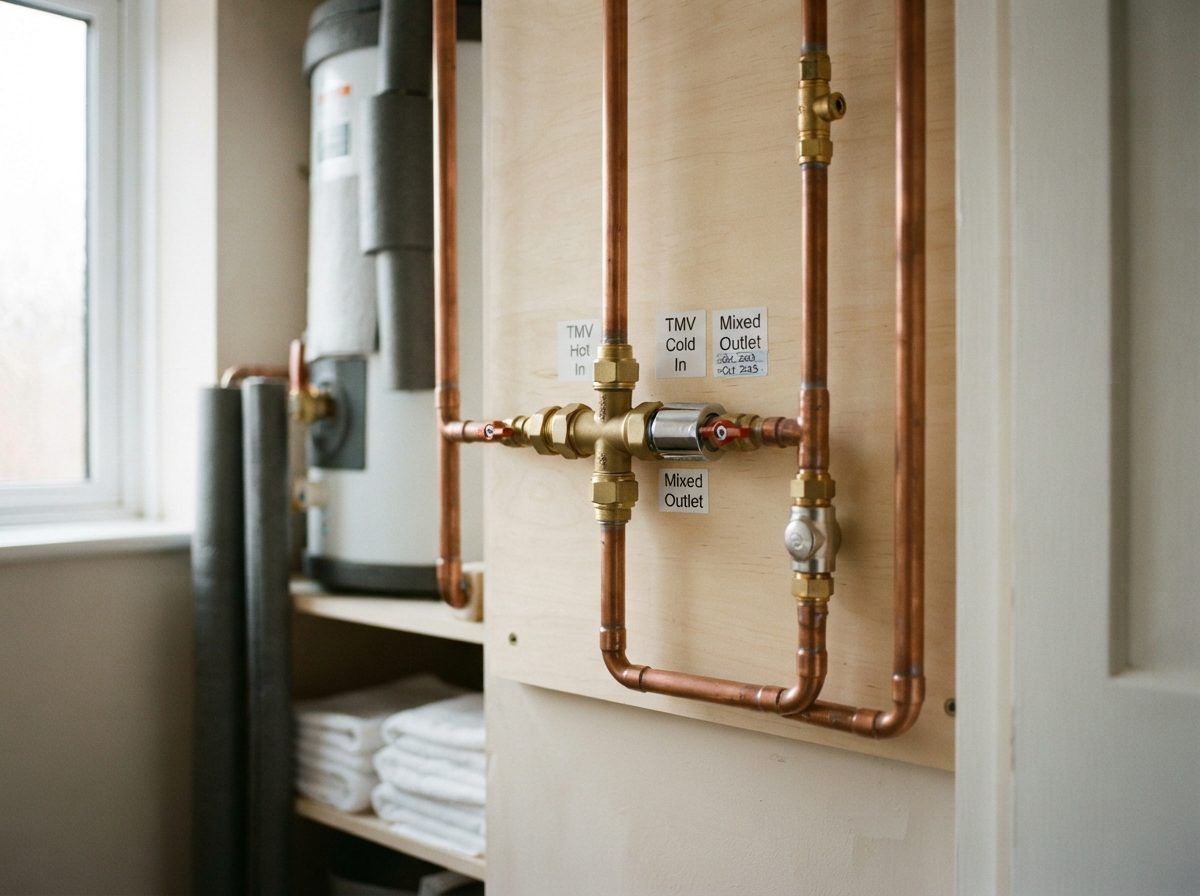
Valves that are easy to forget
In most offices and commercial buildings, TMVs sit under washroom vanities, behind access panels in staff showers or under kitchen sinks. They are rarely the first thing on a facilities manager's mind, and when a building changes hands or a maintenance contractor changes, the history of those valves is often lost. The users are mainly adults, so the scald risk is lower than in a care home or school, but it is not zero: visitors, staff with disabilities, people using cycle-to-work showers after a long ride, and cleaners all use the outlets. This page is for facilities managers, managing agents, building owners and operations managers at offices, retail units, warehouses, factories and similar workplaces.
The duty to control risks from hot water in a workplace falls on the employer and whoever controls the premises, under the Health and Safety at Work etc. Act 1974. ACOP L8 and HSG274 Part 2 cover Legionella, including keeping mixed-water runs short and flushing outlets that see little use. Many commercial buildings have floors let to different tenants, or sparse occupation since hybrid working took hold, which means more outlets standing unused for long periods. TMVs on those outlets need checking as part of the same programme.
This is the right page if you manage commercial premises and want TMVs looked after as a planned item, recorded in a way your CAFM or planned maintenance system can use. If you do not know how many valves the building has, start with a TMV survey or asset register. If you are an approved contractor wanting partner capacity for TMV work across a portfolio, a maintenance contract is likely the better fit.
What commercial TMV servicing covers
The scope follows the outlets in your building and the format your records need to take. Most visits cover:
- Washroom basins and staff showersEach TMV is tested at the outlet for mixed temperature and fail-safe, cleaned and reset where needed.
- Kitchens and tea pointsThermostatic taps and under-sink valves in staff kitchens are tested; outlets that need full hot water for cleaning are noted so they are not wrongly mixed.
- Factory and warehouse welfare areasWash stations, shower rooms and accessible toilets in industrial units are included, often with harder access and older valves.
- Asset taggingValves can be given a unique reference and location so each one appears once in your maintenance system.
- CAFM-ready recordsResults per valve, with asset reference, date, readings and outcome, laid out so they can be uploaded to a CAFM or planned maintenance system.
- Remedial listValves that fail, have no isolation or sit too far from the outlet are listed with suggested work, so you can raise orders against them.
- Compliance pack documentsService records and logbook entries that a building's compliance pack or a tenant's auditor can refer to.
Planning commercial TMV work
-
Out-of-hours or in-hours
Decide whether washrooms can close in turn during the working day or whether the visit should happen early, late or at a weekend.
-
Building access
Arrange passes, sign-in, induction and any permit-to-work steps your site requires, and say whether tenant areas need separate permission.
-
Your record format
Tell us if your CAFM system expects a particular asset reference format or spreadsheet layout, so the records fit without re-typing.
-
Contractor documents
If your site needs risk assessments and method statements from contractors before work, say so in the enquiry.
Good to know for facilities managers
-
Quiet floors need flushing
Outlets on lightly used floors should be flushed and recorded as your written scheme directs, commonly weekly. Hybrid working has made this more common.
-
Not every outlet needs a TMV
Where the risk assessment finds scald risk low, some workplace basins may not need one. Hot water at kitchen sinks used for cleaning may need to stay hot, with warning signs.
-
Valves away from outlets cause problems
A TMV in a ceiling void feeding a basin several metres away leaves warm water sitting in the pipe. These are worth flagging for relocation.
-
Change of contractor is a weak point
When maintenance moves to a new contractor, valve histories often disappear. A survey or asset register gives the new contractor a clean starting point.
How commercial TMV servicing works
- 1
Submit the enquiry form
Give the building address, rough number of washrooms and kitchens, and any access or document requirements.
- 2
Matched to a partner engineer
Alex matches the building, or the portfolio, to a partner engineer nearby.
- 3
Agreed price
The cost depends on valve numbers, access and the records you need. We confirm it before work starts.
- 4
The visit
The engineer signs in, works through washrooms and kitchens as agreed and reports anything urgent on the day.
- 5
Records delivered
A visit usually leaves you with per-valve readings, fail-safe results and a remedial list in a format you can file.
Office and commercial TMV questions
Do offices legally need TMVs?
No law requires a TMV in every office. The employer's risk assessment decides where they are needed, and where they are fitted they must be maintained.
Can records be given in a format for our CAFM system?
Yes, tell us the format in the enquiry. Results can be laid out per valve with asset references that match your system.
Can the work happen out of hours?
Often, yes. Say what times suit your building and we take that into account when matching an engineer.
We manage several sites. Can they be done together?
Yes. Send the list of sites and Alex can match them to partner engineers across the UK, with records in one consistent format.
What about thermostatic taps in kitchens?
They are tested and serviced like other TMVs. Taps used for cleaning that need full hot water are noted rather than turned down.
How often should office TMVs be tested?
Your risk assessment and written scheme set it. Valves that hold temperature well can go longer between tests than ones that drift.
Can you provide RAMS before the visit?
Ask in the enquiry and we will confirm what can be provided before booking.
Related services and sectors
- TMV asset registersOne list of every valve, location and reference to keep in your CAFM.
- Thermostatic tapsServicing the thermostatic taps common in office washrooms and kitchens.
- TMV maintenance contractsPlanned visits across one building or a whole portfolio.
- HotelsMixed-use buildings with hotel floors have their own access patterns.
Bring your building's valves up to date
Send an enquiry with the building and the records you need, and Alex will match it to a partner engineer and confirm the price before work starts.
Send an enquiry