
TMV installation for outlets that have no scald protection
TMV Servicing Specialists arranges TMV installation for homes, rental property and non-domestic buildings across the UK. A partner engineer surveys the outlet, chooses a valve that suits the users and the supplies, fits it close to the tap, bath or shower and sets it before handing over.
When a new valve is the answer
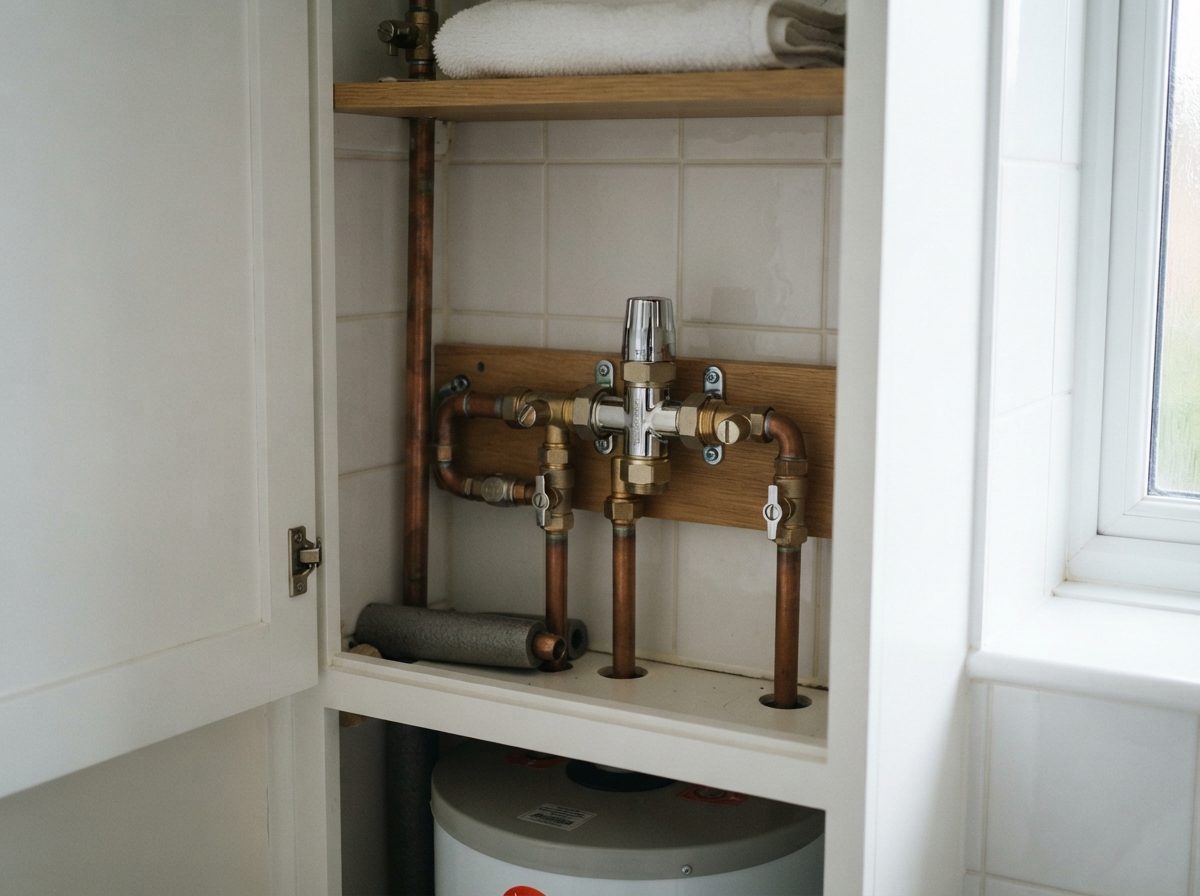
TMV installation means putting a thermostatic mixing valve on an outlet that currently runs straight from the hot supply. It is usually prompted by a change: a bathroom being adapted for an older relative, a house becoming an HMO, a nursery opening in a converted building, a care provider taking on new rooms, or a risk assessment that has flagged a basin or bath running far too hot for the people who use it.
It suits anyone responsible for an outlet where hot water at storage temperature could reach someone vulnerable to scalding: young children, older people, people with reduced sensation or mobility, or anyone who could not move away from hot water quickly. In new homes, and homes formed by change of use, Building Regulations Part G in England and Wales limit hot water to baths to 48°C, and Scotland's building standards set a similar limit, so a new bath outlet in that situation needs a means of limiting temperature from the start.
If a valve is already there but has failed or is the wrong kind, replacement is the better fit. If a contractor has fitted valves and nobody has set or tested them, commissioning is what is needed. Installation is for outlets that have nothing at all, or where an existing arrangement, such as a single valve feeding a whole floor, should be broken down into valves at each outlet.
What a new installation covers
The aim is a valve that matches its setting, is easy to reach later and leaves as little mixed water in the pipe as possible.
- Outlet and user surveyThe engineer looks at each outlet, who uses it and how: a hand basin in a nursery toilet is a different job from an assisted bath in a care setting, and the outlet type sets the maximum mixed temperature.
- Supply temperatures and pressuresHot and cold temperatures are measured and the supply arrangement is noted, whether mains-fed, unvented, gravity-fed from a tank, or a combination boiler. Pressures matter because a valve is only approved for the conditions it was tested under.
- Choosing TMV2 or TMV3TMV2 covers domestic-type use and TMV3 the higher-performance scheme used in healthcare and similar settings. Some valves hold both. The choice follows the setting, any requirement from a commissioner or regulator, and the supply pressures on site.
- Isolation valves and strainersEach supply into the valve should have an isolating valve and a strainer, or a valve with them built in, so that future servicing and fail-safe tests can be done without draining down the system.
- Siting close to the outletMixed water should travel as short a distance as practical before it reaches the user. Short mixed runs help Legionella control, because water below 50°C sitting in a long pipe is the condition the bacteria favour.
- Access for later workThe valve is placed where it can be reached without removing tiles or bath panels fixed with sealant: under a basin, behind a screwed panel, or in a cupboard with a door.
- Setting and commissioningThe outlet temperature is set for the outlet type, the fail-safe response is tested by isolating the cold supply, and the readings are recorded as the baseline for future tests.
- HandoverYou should expect the settings, fail-safe result and dates for the first in-service tests to be written down per valve, plus notes on where each valve and its isolators are.
Before you book an installation
-
List the outlets and who uses them
A simple note of each room, the outlet type and the people who use it lets the job be matched to the right engineer and valve type from the start.
-
Find out how hot water is supplied
Combination boiler, cylinder with a tank in the loft, unvented cylinder or a central plant room: each changes the pressures the valve must cope with and which valves are suitable.
-
Check what any regulator or commissioner expects
Care providers, health settings and some housing providers have contract terms or local policy that call for TMV3 valves. Knowing this before the survey avoids fitting a valve that later has to come out.
-
Think about access and finishes
If a bathroom is about to be tiled or boxed in, plan an access panel now. Fitting a valve into a finished room usually means opening something up.
Worth knowing about new TMVs
-
One valve per outlet is usually preferred
A single valve serving several outlets creates long runs of mixed water and makes it hard to set each outlet to its own limit. Guidance favours a valve at, or very near, each outlet.
-
Stored water still needs to be hot
A TMV does not replace the need to store hot water at about 60°C for Legionella control. It lets the store stay hot while the water at the outlet is safe to use.
-
Water fittings rules apply
New fittings connected to the public supply fall under the Water Supply (Water Fittings) Regulations 1999 in England and Wales, the Scottish Water Byelaws 2014 in Scotland, and the 2009 Northern Ireland regulations.
-
A new valve needs testing, not just fitting
Under the D 08 approach, a newly commissioned valve is tested again at about 6-8 weeks and 12-15 weeks, and the drift seen in those tests sets its longer-term interval.
How an installation is arranged
- 1
Describe the outlets
Use the enquiry form to tell us the building, the outlets you want protected, who uses them and how hot water is supplied. Photos of the pipework help.
- 2
Alex finds the engineer
Alex matches the job to a partner engineer who covers your area and fits TMVs in your kind of building.
- 3
Survey and price
The engineer may need to see the site before pricing, especially where pipework is hidden or the supply is unusual. The price is agreed with you before any work starts.
- 4
Fitting and setting
The valve is installed with isolators and strainers, the temperature is set for the outlet and the fail-safe is checked.
- 5
Records and next tests
You receive the commissioning readings for each valve and the dates its first in-service tests fall due.
Questions about TMV installation
Can a TMV be fitted to any tap or shower?
Most basin, bath and shower outlets can take a TMV, either as a separate valve on the pipework or as a thermostatic tap or shower with the control built in. The choice depends on space, access and supply pressures.
Do I need TMV2 or TMV3?
Homes and domestic-type settings usually use TMV2. Care homes, hospitals and similar settings normally use TMV3, and some contracts require it. The survey confirms which approval suits your setting and supplies.
What temperature will it be set to?
D 08 commonly quotes 41°C for basins and showers, 44°C for baths and 38°C for bidets, with up to 46°C for an assisted bath fill where a carer is present. A lower setting can be chosen where your risk assessment calls for it.
Does installation need the water turned off?
Yes, the supplies to that outlet need isolating while the valve is connected. The engineer can explain the extent of the shutdown when the job is planned.
How much does TMV installation cost?
The price depends on the number of outlets, access, the type of valve and how much pipework has to change. It is confirmed with you before work starts.
Will the new valve need maintenance?
Yes. A TMV needs regular testing and periodic servicing, with strainers cleaned and checked. Fitting it where it can be reached keeps that work simple.
Related TMV work
- TMV commissioningFor valves already fitted by a builder or contractor that still need setting, testing and a baseline record.
- TMV3 valvesWhat the higher-performance scheme involves and where it is expected.
- Thermostatic tapsWhere a tap with built-in thermostatic control suits better than a separate valve.
- TMV2 vs TMV3A guide to the two schemes and how to choose between them.
Need TMVs fitted where there are none?
Tell us the building, the outlets and who uses them. Alex will match the installation to a partner engineer and confirm the price before any work starts.
Send an enquiry